Build a Job Queue with Standalone Activities
Introduction
By Angela Zhou, Senior Developer Advocate at Temporal
You're going to build a durable webhook delivery service.
When something happens in your application, such as a payment clearing, an order shipping, or a user signing up, you POST to a URL another team gave you. Doing it durably means three things: retry if the network fails, retry if the receiver returns a 500, and never double-deliver if your service crashes mid-send.
Standalone Activities are Temporal's durable job queue. You write a regular @ActivityInterface method and submit it with one API call. Temporal persists it, retries it on failure, and makes it visible in the UI, with no broker, scheduler, or result store for you to operate.
What you'll learn
By the end you'll be able to:
- Submit an Activity as a durable, addressable job with
ActivityClient.execute/ActivityClient.start. - Make retries safe with an idempotency key so a crash can't double-deliver.
- Reject duplicate submissions at the server with
ActivityIdConflictPolicy.ACTIVITY_ID_CONFLICT_POLICY_USE_EXISTING. - Cap dispatch rate with
setMaxWorkerActivitiesPerSecondand prioritize urgent work. - Heartbeat a long-running Activity and resume it from the last checkpoint after a crash.
- Reuse the exact same Activity as a step inside a Workflow, with no rewrite.
Prerequisites
- Familiar with Temporal Activities and Workers at the level Temporal 101 in Java covers.
Standalone Activities arrived in the Temporal Java SDK in version 1.35.0, and the course repo pins 1.36.1. ActivityClient, StartActivityOptions, and ActivityHandle are annotated @Experimental while the feature is in Public Preview, so pin a recent SDK and expect the API to settle further. They also require Temporal Server 1.31 or newer, which ships bundled with Temporal CLI 1.7 and later.
Run the lab in your browser (recommended)
This tutorial is built as a Free, hands-on Instruqt lab. Nothing to install: the Temporal Service, the Web UI, and a webhook receiver all boot with the sandbox, so you start writing code immediately.
Run the code locally (optional)
Prefer to run it yourself? Clone the course repo and start the pieces the sandbox normally boots for you:
You'll need a few things installed first:
- Git.
- A JDK 21 or newer. Each module declares a Java 21 Gradle toolchain.
- Gradle. The modules are plain Gradle projects with no wrapper checked in, so you run them with an installed
gradle. - Python 3. The webhook receiver is a shared, standard-library-only script reused across the language tracks, so it isn't vendored into the Java folder.
- The Temporal CLI, which provides the local dev server. Use a recent version so the Standalone Activities features (the
Standalone ActivitiesUI tab,temporal activitycommands, conflict policies) are available.
git clone https://github.com/temporalio/edu-standalone-activities.git
cd edu-standalone-activities/java
Then, in separate terminals:
# Webhook receiver (records what your Worker delivers)
python3 ../shared/webhook-receiver/webhook_receiver.py

# Temporal dev server + Web UI on http://localhost:8233
temporal server start-dev --ui-port 8233

# A module's Worker
cd course-repo/exercise/01-durable-job-queue
gradle -q execute -PmainClass=webhook.Worker

# Submit a job (in another terminal, from the same module folder)
gradle -q execute -PmainClass=webhook.SendStandalone -PappArgs=evt_001
curl http://localhost:9000/_received
Each module has parallel course-repo/exercise/<NN> (starter code with TODO markers) and course-repo/solution/<NN> folders, and each one is a self-contained Gradle project. If you get stuck, diff your work against the matching solution/ folder.
You may hit environment setup issues (JDK version, Gradle installation, dependency downloads, port conflicts, Temporal CLI installation) that we can't control or support. The Instruqt lab is the supported path. Use localhost only if you're comfortable troubleshooting your own setup.
Module 1: Submit a durable job with one API call
Running background jobs the traditional way means wiring up several moving parts yourself: a broker to hold the jobs until something runs them, a scheduler to decide when they run, and retry logic re-written in every service. Glue those together and you've built a Tier-0 system (one everything depends on, so it can never go down) that someone has to keep alive. Temporal doesn't make those concerns disappear, but it consolidates them onto one platform instead of four systems you stitch together. You write a regular Activity and submit it with a single call; Temporal holds the job, schedules it, and retries it for you:
// A regular annotated interface; nothing here marks it "standalone".
@ActivityInterface
public interface WebhookActivities {
    int deliverWebhook(WebhookDelivery request);
}
public class WebhookActivitiesImpl implements WebhookActivities {
    private static final HttpClient httpClient = HttpClient.newHttpClient();
    private static final ObjectMapper objectMapper = new ObjectMapper();

    @Override
    public int deliverWebhook(WebhookDelivery request) {
        try {
            HttpRequest httpRequest = HttpRequest.newBuilder(URI.create(request.getUrl()))
                    .header("Content-Type", "application/json")
                    .POST(HttpRequest.BodyPublishers.ofString(
                            objectMapper.writeValueAsString(request.getPayload())))
                    .build();
            HttpResponse<String> response =
                    httpClient.send(httpRequest, HttpResponse.BodyHandlers.ofString());
            if (response.statusCode() >= 300) {
                throw new RuntimeException("HTTP " + response.statusCode()); // a 4xx/5xx throws, so Temporal retries
            }
            return response.statusCode();
        } catch (IOException | InterruptedException e) {
            throw new RuntimeException(e); // a network error throws too, so Temporal retries
        }
    }
}
Submitting it is one call on an ActivityClient, the job-queue sibling of the WorkflowClient you already know:
ActivityClient client = ActivityClient.newInstance(
        service, ActivityClientOptions.newBuilder().setNamespace("default").build());

StartActivityOptions options = StartActivityOptions.newBuilder()
        .setId("deliver-" + eventId)
        .setTaskQueue(Webhook.TASK_QUEUE)
        .setStartToCloseTimeout(Duration.ofSeconds(10))
        .build();

int status = client.execute(
        WebhookActivities.class, WebhookActivities::deliverWebhook, options, request);
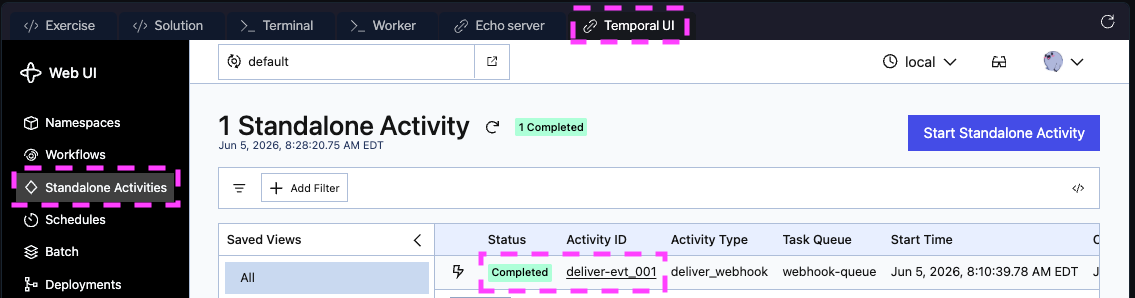
There's no "standalone" annotation and no Workflow interface. Standalone versus inside-a-Workflow is decided by how the Activity is called, not how it's defined: the same @ActivityInterface method reference works either way. The job is addressable (a stable ID you can query, cancel, or terminate), durable (persisted before your Worker sees it), and observable in the Temporal UI under the Standalone Activities tab:
To be clear about what doesn't change: your application's own data still lives in your database, and someone still operates Temporal (your team, or Temporal Cloud). What you stop doing is running a separate broker, scheduler, and retry layer and wiring them together.
Check your understanding: your job hits a transient 503 on attempt 1. With Temporal's default retry policy, what happens?
Answer
Temporal sees the thrown exception, waits the initial retry interval (1s by default), and dispatches the job again with exponential backoff. You wrote no retry code; you configured it on the Activity options. The job stays "Running" in the UI and the attempt counter increments. In a traditional job queue, that retry behavior is something you re-implement per service.
Never miss a new tutorial
Be the first to know when we ship new tutorials, courses, and hands-on guides. No spam, unsubscribe anytime.
Join the Temporal education list →No spam, unsubscribe anytime.
Module 2: Make retries safe with idempotency
Temporal guarantees your Activity runs to completion at least once, not exactly once. If the POST lands and then the attempt errors (a 500, a dropped network, a Worker crash after the POST), Temporal retries the whole Activity body and the receiver gets the same delivery twice. The fix is a stable idempotency key the receiver dedupes on:
HttpRequest httpRequest = HttpRequest.newBuilder(URI.create(request.getUrl()))
        .header("Content-Type", "application/json")
        // The event id is stable across retries, so every attempt POSTs the same
        // logical delivery key and the receiver dedupes the side effect.
        .header("Idempotency-Key", "webhook:" + request.getEventId())
        .POST(HttpRequest.BodyPublishers.ofString(body))
        .build();
The key is derived from the logical event id, so it's identical across every retry of that event. Don't use UUID.randomUUID(): a fresh key per attempt dedupes nothing. At-least-once delivery (Temporal) + idempotency (your Activity and receiver) = effectively-once side effects.
Step through the with/without comparison:
Check your understanding: your Activity builds the
Idempotency-Keyfrom aUUID.randomUUID()generated inside the Activity. What breaks on retry?
Answer
Each retry generates a different random value, so the key changes per attempt and the receiver accepts every one. Make the key deterministic across retries: derive it from input the caller chose (request.getEventId()), or for workflow-bound Activities combine getWorkflowRunId() and getActivityId() from Activity.getExecutionContext().getInfo(). If you need the random value as part of the side effect, generate it in the caller and pass it in as input.
Module 3: Reject duplicate jobs at the platform
Module 2 handled Temporal's own retries. This module handles a different duplicate: your upstream (Stripe, GitHub, a customer's service) sends the same event twice and you call ActivityClient.start twice. By default the second call with the same Activity ID errors out. One option makes the server return a handle to the existing Activity instead:
import io.temporal.api.enums.v1.ActivityIdConflictPolicy;

StartActivityOptions options = StartActivityOptions.newBuilder()
        .setId("deliver-" + eventId)
        // ...
        .setIdConflictPolicy(ActivityIdConflictPolicy.ACTIVITY_ID_CONFLICT_POLICY_USE_EXISTING)
        .build();

ActivityHandle<Integer> handle = client.start(
        WebhookActivities.class, WebhookActivities::deliverWebhook, options, request);
Both calls now return a handle for the same running Activity, and the duplicate never reaches a Worker. This is scheduling-layer dedup; it composes with the receiver-side idempotency key from Module 2.
Check your understanding: with
USE_EXISTINGset, you callclient.startwithsetId("deliver-evt_001")twice, but the second call arrives 60 seconds after the first one already completed. What happens?
Answer
A new execution starts. The ID conflict policy only governs duplicates while the original is in flight. Once it completes, the ID reuse policy takes over, and its default (ACTIVITY_ID_REUSE_POLICY_ALLOW_DUPLICATE) accepts a fresh run. For dedup across both windows, also set .setIdReusePolicy(ActivityIdReusePolicy.ACTIVITY_ID_REUSE_POLICY_REJECT_DUPLICATE).
Module 4: Cap throughput and prioritize urgent jobs
By default the Worker executes Activities as fast as it can process them, which may be faster than the downstream service allows. If the receiver is rate-limited, you will get a flood of "Too Many Requests" errors and climbing retry counts:
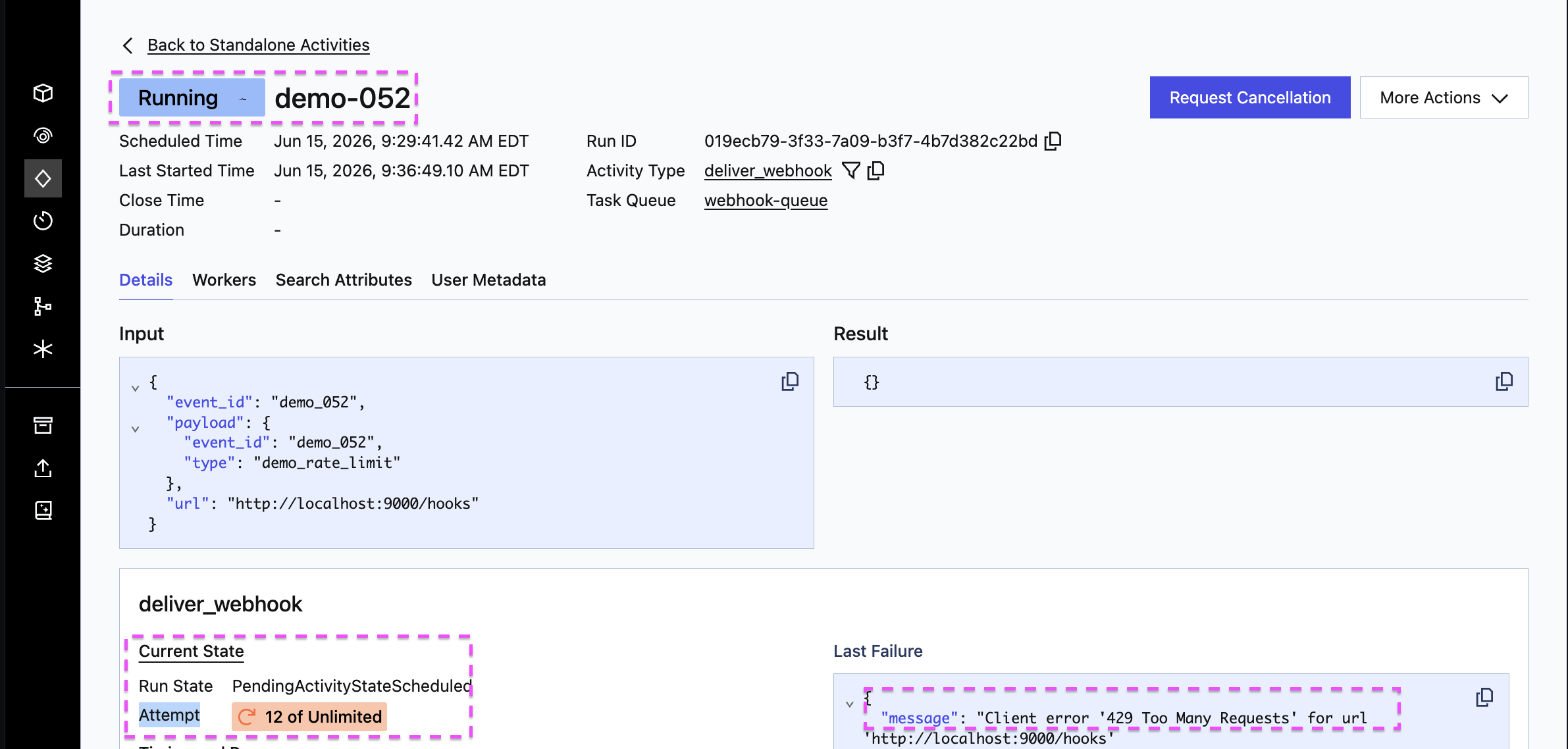
The problem here isn't one slow job; it's the combined request rate of every delivery hitting a receiver that only allows so many per second. Temporal retries each Activity on its own, which fixes a one-off failure but can't fix a total-rate problem: every retry is just another request piling onto an already-overloaded receiver. The fix is to slow how fast the work goes out. One option on the Worker does it:
WorkerOptions options = WorkerOptions.newBuilder()
        .setMaxConcurrentActivityExecutionSize(10)
        .setMaxWorkerActivitiesPerSecond(2) // cap how fast this Worker starts Activities
        .build();

var worker = factory.newWorker(Webhook.TASK_QUEUE, options);
worker.registerActivitiesImplementations(new WebhookActivitiesImpl());
Excess work waits in the Task Queue on the server, dispatched at the configured rate. Nothing is dropped. The companion control is StartActivityOptions.setPriority, which takes a Priority built from setPriorityKey, setFairnessKey, and setFairnessWeight: a lower priority key jumps urgent work ahead of a backlog, and the fairness fields stop one busy tenant from starving the rest. See Task Queue Priority and Fairness.
Check your understanding: your downstream API allows 100 req/sec. You set
setMaxWorkerActivitiesPerSecond(10)on one Worker. Are you safe?
Answer
For this exact setup, one Worker, yes, but you're only using 10% of the downstream's 100 req/sec headroom. The catch: setMaxWorkerActivitiesPerSecond is per Worker, not global. Add a second Worker and you're at 20/sec; run 11 and you're at 110/sec, past the limit. So "safe" only holds while the Worker count stays fixed. For a cap that holds no matter how many Workers poll the queue, use setMaxTaskQueueActivitiesPerSecond.
Module 5: Heartbeat progress and resume after a crash
A Standalone Activity that processes a batch can run for minutes. If the Worker crashes mid-batch, you don't want the retry to redo everything. Standalone Activities have heartbeats built in: context.heartbeat(progress) stores a checkpoint on the server, and the next attempt reads it back:
ActivityExecutionContext context = Activity.getExecutionContext();

int startIndex = 0;
Optional<Integer> checkpoint = context.getHeartbeatDetails(Integer.class);
if (checkpoint.isPresent()) {
    startIndex = checkpoint.get(); // resume from the last checkpoint
}
// ... deliver items from startIndex, calling context.heartbeat(delivered) after each one
Pair it with .setHeartbeatTimeout(Duration.ofSeconds(5)) on the submit call so the server detects a dead or stuck attempt in seconds instead of waiting out the full start-to-close timeout. Heartbeating is also how cancellation reaches a running Activity. No side database required.
Check your understanding: your batch Activity has a 5-second heartbeat timeout and processes one item per second. Mid-batch the Worker hangs (a deadlock, not a crash) and stops heartbeating. What does Temporal do?
Answer
After 5 seconds with no heartbeat, Temporal treats the attempt as dead, the same as a crash, and schedules a retry on whatever Worker picks it up next. That's the point of the heartbeat timeout: a liveness signal that lets the server route around a stuck Worker quickly, rather than waiting for the much longer start-to-close timeout.
Module 6: Same code runs anywhere
Traditional job queues paint you into a corner: the queue runs jobs, orchestration lives elsewhere, and code gets rewritten when a job becomes multi-step. With Temporal, the exact same Activity runs both ways. Submit deliverWebhook directly or call it as a step inside a Workflow:
public class WebhookWorkflowImpl implements WebhookWorkflow {
    private final WebhookActivities activities = Workflow.newActivityStub(
            WebhookActivities.class, // the SAME interface
            ActivityOptions.newBuilder()
                    .setStartToCloseTimeout(Duration.ofSeconds(10))
                    .build());

    @Override
    public int run(WebhookDelivery request) {
        return activities.deliverWebhook(request);
    }
}
The same Worker registers both, and the Activity doesn't know whether it was invoked as a Standalone Activity or a Workflow step. That's the differentiator: one tool for jobs and orchestration. With Temporal the same Activity becomes a step in a Workflow on the same platform: same retries, timeouts, and visibility, and no second system to run.
At Replay 2026, Coinbase described migrating their custom Background Jobs Service, which handles 200–600 million jobs per day across 186 namespaces, onto Standalone Activities, letting one platform replace a separate job queue and orchestrator. (Watch the talk.)
Wrap-up
You now know how to use Standalone Activities in Java to:
- Submit a durable job with
ActivityClient.execute/ActivityClient.start, no Workflow required. - Make retries safe with a stable idempotency key for external writes.
- Dedup duplicate submissions at the server with
ActivityIdConflictPolicy.ACTIVITY_ID_CONFLICT_POLICY_USE_EXISTING. - Pace and prioritize with
setMaxWorkerActivitiesPerSecondandStartActivityOptions.setPriority. - Checkpoint long-running jobs with
context.heartbeat()+ a heartbeat timeout. - Reuse the same Activity from a Workflow when the work grows into orchestration.
Temporal lets you start with a job and move to a Workflow when the work grows, and the Activity code comes with you.
Ready to build it for real? Launch the hands-on lab using the sign-up form at the top of this page.
📝 Feedback on this tutorial? Share your thoughts in our quick form. It helps us improve.